Designing metropolitan fiber transport networks for smart cities, telecom service providers, and utility control grids requires a fundamental architectural decision: choosing between Gigabit Passive Optical Networks (GPON) and Point-to-Point Active Ethernet (AE). While both optical standards deliver high-speed broadband, their underlying physical topologies, optical split ratios, throughput allocation models, and lifetime capital cost structures differ dramatically. This comprehensive technical guide provides an exhaustive engineering and financial evaluation to aid network architects in selecting the optimal fiber architecture.
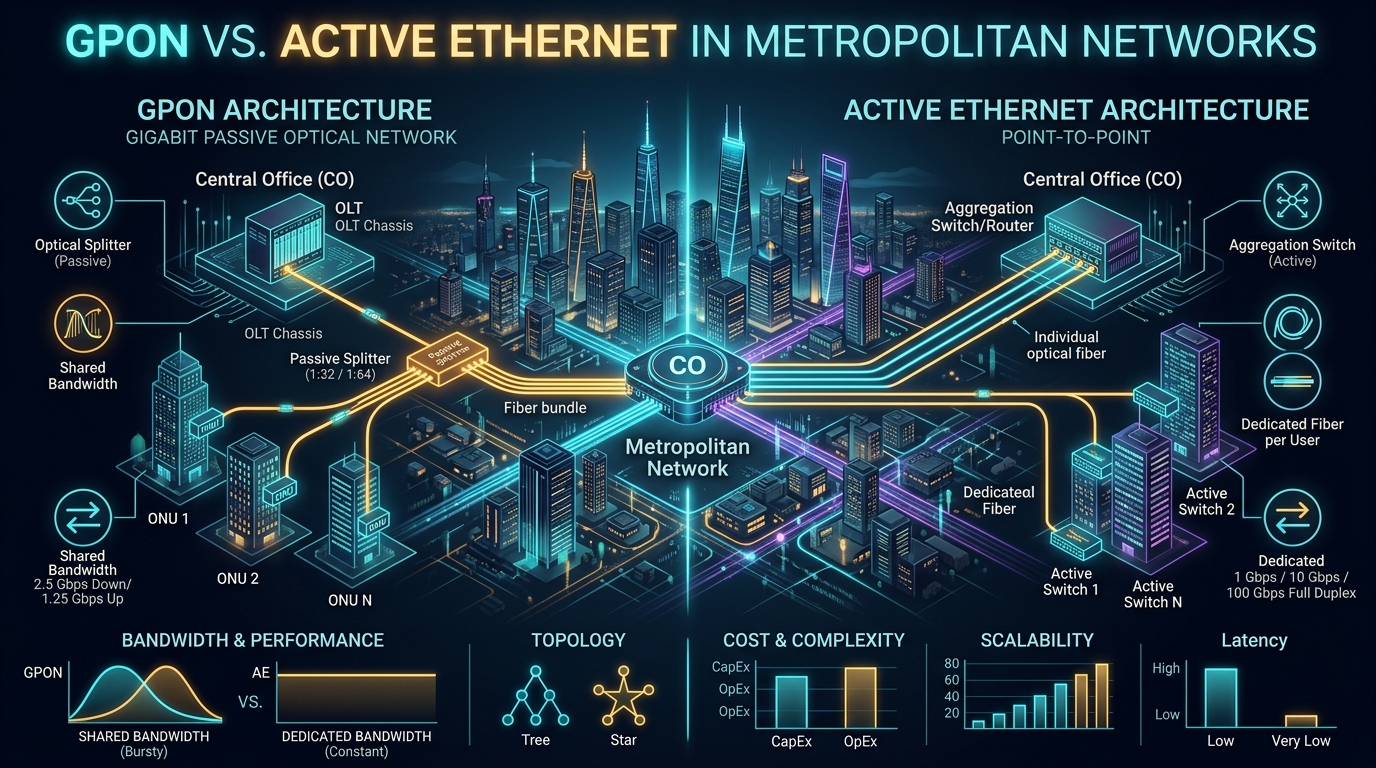
Figure 1: High-level optical topology comparison showing passive splitter trees versus dedicated active switch links.
1. Point-to-Multipoint GPON Architecture
The fundamental distinction between GPON and Active Ethernet lies in how light signals are multiplexed and routed through the physical optical distribution network (ODN): GPON (Point-to-Multipoint Passive Architecture): GPON relies on unpowered, passive optical splitters (typically 1:32 or 1:64 split ratios) deployed in outdoor cabinets or splice closures. A single feeder fiber strand originating from an Optical Line Terminal (OLT) port at the Central Office (CO) carries signals to a splitter, which divides the optical power among up to 64 subscriber Optical Network Units (ONUs). Downstream data operates at 1490nm (continuous broadcast encrypted with AES-128); upstream data operates at 1310nm using Time Division Multiple Access (TDMA) burst-mode transmission. A single GPON port delivers 2.488 Gbps downstream and 1.244 Gbps upstream shared across all ONUs on that PON tree.
Dynamic Bandwidth Allocation (DBA) algorithms dynamically assign transmission time slots to individual ONUs based on real-time traffic demand, preventing high-bandwidth subscribers from choking the shared feeder fiber link.
2. Point-to-Point Active Ethernet Architecture
Active Ethernet (Point-to-Point Dedicated Architecture): Active Ethernet connects every end subscriber directly to an active field switch or central office switch using dedicated fiber strands. Each customer node receives a dedicated, non-oversubscribed, unshared optical transceiving link operating under standard IEEE 802.3ah Ethernet framing. This point-to-point layout guarantees dedicated 1 Gbps or 10 Gbps symmetrical bandwidth without competing subscriber traffic.
Because Active Ethernet operates without optical splitters, there is zero Time Division contention. End users enjoy continuous, unbuffered throughput with sub-millisecond latency, making it the preferred architecture for enterprise data centers and critical utility SCADA backbones.
Figure 2: Comprehensive Engineering Matrix
Fiber Infrastructure
GPON reduces feeder fiber by 85%; AE requires high-density fiber count cables.
Active Power (OPEX)
GPON uses zero field power; AE requires outdoor cabinets with active cooling & UPS.
Throughput Guarantee
GPON shares TDM capacity; AE delivers guaranteed 1G/10G symmetrical throughput.
Distance Reach
GPON splitters limit reach to 20 km; AE point-to-point optics extend beyond 70 km.
3. Optical Link Budget & Attenuation Analysis
Designing an optical link requires calculating maximum attenuation boundaries. In GPON networks, the optical power budget must absorb massive splitter insertion losses: 1:2 Splitter = 3.5 dB loss. 1:4 Splitter = 7.2 dB loss. 1:8 Splitter = 10.5 dB loss. 1:16 Splitter = 13.8 dB loss. 1:32 Splitter = 17.1 dB loss. 1:64 Splitter = 20.5 dB loss. Combined with fiber attenuation (0.35 dB/km at 1310nm, 0.22 dB/km at 1550nm), fusion splice losses (0.05 dB each), and connector losses (0.3 dB per pair), GPON Class B+ optics (28 dB budget) restrict maximum feeder distance to 20 kilometers. Conversely, Active Ethernet optical links suffer no splitter attenuation, allowing standard SFP+ optics to achieve distances of 40 km to 80 km without optical amplification.
4. Capital Expenditure (CAPEX) Financial Modeling
When designing large-scale municipal or enterprise networks, capital expenditure (CAPEX) and operational expenditure (OPEX) drive the decision matrix: Civil Works Protection: In high-density urban areas, trenching and duct leasing represent up to 70% of total deployment costs. GPON’s ability to serve 64 users on a single fiber strand provides massive civil savings over Active Ethernet. Central Office Footprint: GPON OLT line cards require far fewer optical ports and less rack space than high-density Active Ethernet switch chassis. Cable Sizing: GPON requires smaller 12-core or 24-core feeder cables, whereas AE requires 144-core or 288-core cables for identical subscriber counts.
5. Operational Expenditure (OPEX) & Lifecycle Maintenance
Operational Expenditure (OPEX) Evaluation: Field Powering: GPON splitters are entirely passive, requiring zero electricity, HVAC cooling, or backup batteries in field cabinets. AE requires powered outdoor cabinets with continuous maintenance overhead. Troubleshooting & MTTR: Point-to-Point Active Ethernet simplifies fault isolation, as OTDR traces directly pinpoint individual broken fiber drops without encountering optical splitter attenuation walls. Power Consumption: GPON central office equipment consumes significantly less wattage per subscriber compared to active field Ethernet switches.
6. Future Migration Paths: XGS-PON and 25G-PON
As bandwidth demands increase, GPON networks can be seamlessly upgraded to XGS-PON (10 Gbps symmetrical) or 25G-PON over the existing passive optical distribution network (ODN). Because WDM filters isolate wavelengths, XGS-PON (1577nm downstream, 1270nm upstream) can co-exist on the exact same fiber strand as legacy GPON without disturbing active subscribers.
7. Architectural Selection Framework
Decision Matrix for Network Architects: Select GPON for high-density residential Fiber-to-the-Home (FTTH), cost-sensitive municipal rollouts, and environments where civil duct capacity is severely limited. Select Active Ethernet for high-capacity enterprise connections, low-latency utility SCADA substation trunks, dedicated data center interconnects, and cellular backhaul (C-RAN/5G) requiring zero jitter and unshared throughput.
8. Fiber Cable Density & Civil Conduit Space Optimization
In metropolitan telecommunications engineering, underground civil conduit space is often severely congested. Duct leasing fees paid to municipal authorities or electric utilities represent a recurring operational expense that scales directly with cable outer diameter.
GPON offers a massive advantage in conduit utilization. Because a single 12-core micro-cable can serve over 768 end subscribers using 1:64 splitting trees, network operators can pull high-count fiber micro-cables into existing 40mm sub-ducts without excavating new city streets. In contrast, deploying Active Ethernet for 768 subscribers would require multiple 288-core cables, forcing expensive civil trenching and additional duct bank construction.
9. Energy Efficiency & Carbon Footprint Analysis
As telecommunications service providers align with corporate Environmental, Social, and Governance (ESG) mandates, energy consumption per subscriber has become a critical evaluation metric.
GPON architectures demonstrate superior power efficiency. Central Office OLT line cards consume approximately 0.5 to 1.5 Watts per active subscriber port. Furthermore, because field splitters are completely passive, zero electrical power is consumed between the Central Office and customer premises.
Point-to-Point Active Ethernet requires powered field switches housed in environmentally controlled outdoor cabinets. These cabinets require continuous AC power for switch power supplies, active fan cooling, cabinet heaters in cold climates, and battery backup UPS units. An Active Ethernet deployment typically consumes between 3.5 to 6.0 Watts per subscriber port—a 4x to 6x increase in continuous electrical power draw compared to GPON.
10. Optical Wavelength Grid Engineering & Fiber Aging Considerations
When designing optical distribution networks intended for a 25-year to 30-year operational lifespan, network architects must account for long-term physical fiber degradation and wavelength spectrum planning.
Over decades of field operation, buried and aerial optical cables suffer micro-bending losses due to thermal expansion, cable strain, accidental dig-up repairs requiring additional fusion splices, and hydrogen aging attenuation spikes. A robust optical budget design includes a 3.0 dB safety margin specifically allocated for cable aging and future maintenance repairs.
Furthermore, spectral planning isolates GPON (1490nm/1310nm), XGS-PON (1577nm/1270nm), and RF video overlay (1550nm) using Coexistence Element (CE) passive filters. This multi-wavelength strategy enables zero-downtime speed upgrades, allowing utilities to scale bandwidth from 2.5G up to 10G and 25G over identical physical glass strands without replacing underground field infrastructure.
11. Network Survivability, Protection Switching & Ring Topologies
Mission-critical utility telecommunications and high-tier enterprise connections require high availability and sub-50ms fault recovery. Evaluating survivability mechanisms highlights key trade-offs between GPON and Active Ethernet architectures.
GPON networks implement Type B and Type C protection switching specified under ITU-T G.984. Type B protection provides dual-parented OLT ports and redundant feeder fibers connected to 2:N optical splitters. If a primary feeder cable is severed, the OLT automatically switches to the backup feeder within 50 milliseconds. Type C protection extends redundancy down to dual ONU transceiver ports, providing end-to-end physical path protection.
Active Ethernet networks utilize standardized IEEE 802.1w Rapid Spanning Tree Protocol (RSTP) or ITU-T G.8032 Ethernet Ring Protection Switching (ERPS) over physical ring topologies. Active Ethernet rings deliver deterministic 50ms self-healing re-routing around physical fiber cuts, ensuring continuous telemetry transmission for high-voltage substation switchgear and smart grid SCADA master controllers.
12. Summary & Strategic Recommendation Matrix
In summary, network architects must evaluate both immediate capital budgets and 30-year operational costs when selecting optical transport architectures. GPON remains the dominant choice for mass-market residential Fiber-to-the-Home (FTTH) and cost-constrained municipal smart city networks due to its unmatched civil duct savings and zero field power consumption.
Point-to-Point Active Ethernet serves specialized high-performance niches: high-density enterprise data center interconnects, dedicated utility SCADA trunks requiring zero jitter, and cellular backhaul loops where unshared symmetrical throughput is strictly required. Understanding these architectural trade-offs ensures network investments remain resilient, scalable, and cost-effective over decades of technological evolution.
Academic & Industry References
- ITU-T. (2016). ITU-T G.984.1: Gigabit-capable passive optical networks (GPON). International Telecommunication Union.
- IEEE 802.3ah Working Group. (2004). Media Access Control Parameters, Physical Layers, and Management Parameters for Subscriber Access Networks. IEEE.
- Keiser, G. (2013). FTTH Technologies and Performance Comparison (2nd ed.). McGraw-Hill.