Large-scale telecommunications deployments—such as 5G Standalone (SA) Cloud Core rollouts, Open RAN (O-RAN) radio deployments, and BSS/OSS digital transformation programs—involve complex ecosystems of concurrent software, firmware, and API deliverables executed across dozens of external sub-contractors, system integrators, and equipment vendors. Traditional Waterfall management struggles in these multi-vendor environments due to rigid interface assumptions and late-stage integration bottlenecks. Conversely, uncoordinated Agile execution leads to API drift, scope friction, and missed commercial launch dates. This comprehensive guide outlines a Scaled Agile Sprint Integration Framework designed to synchronize multi-vendor software deliverables while maintaining contractual commercial governance.
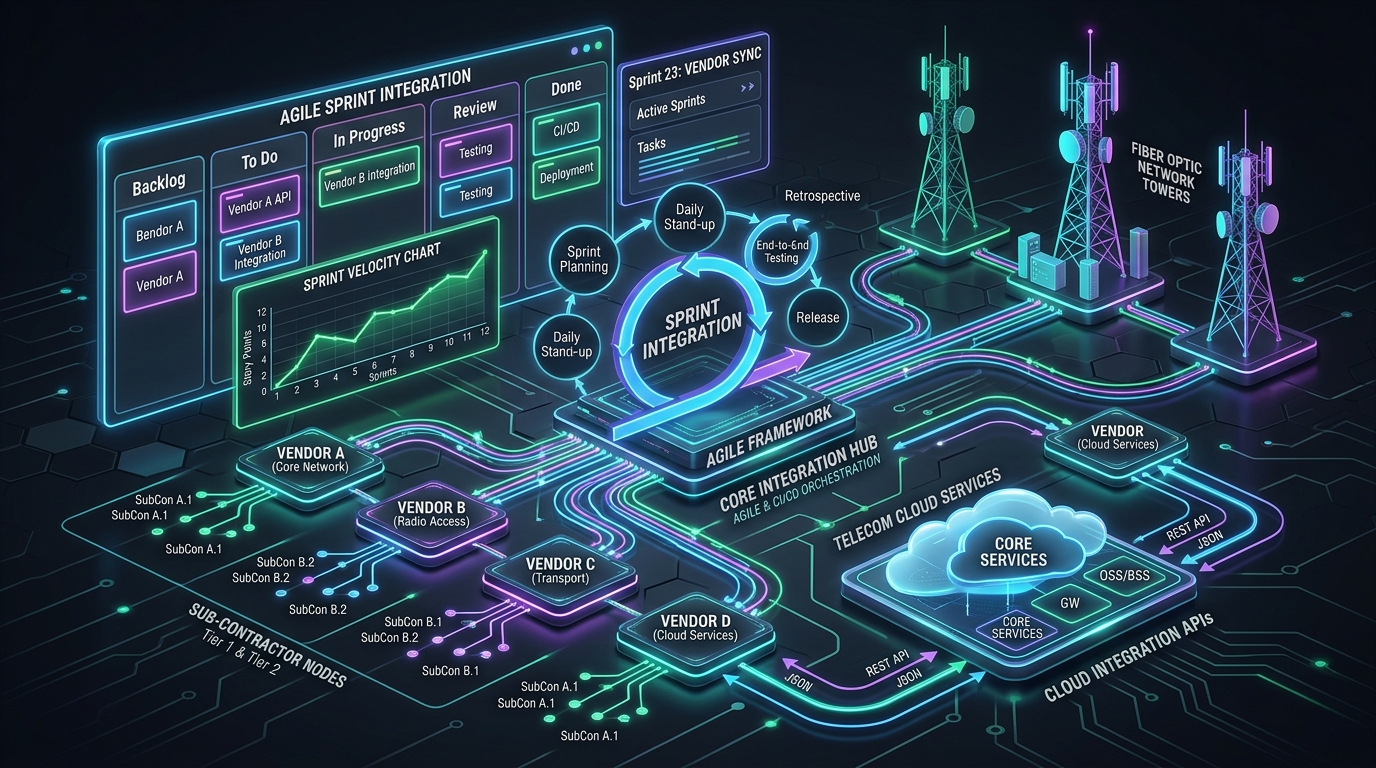
Figure 1: Scaled Agile Release Train architecture synchronizing sub-contractor sprint deliverables into a unified staging pipeline.
1. The Multi-Vendor Integration Challenge
Multi-vendor telecom projects operate under severe architectural and organizational complexity. A single end-to-end service launch (e.g. 5G network slicing) requires simultaneous integration between network function vendors (AMF, UPF, SMF), radio access network (gNodeB) software providers, cloud infrastructure orchestrators (Kubernetes/OpenStack), and billing/charging (CHF/Nchf) software contractors. When multiple independent vendors develop code using isolated sprint cadences, three systemic failure modes emerge: API Interface Drift: Vendor A modifies RESTful JSON payload schemas or gRPC proto definitions without notifying Vendor B, causing pipeline failures during joint integration testing. Asynchronous Definition of Done (DoD): Vendor C considers a software module “Done” when local unit tests pass, while the primary operator requires full continuous integration (CI) staging validation. Contractual Scope Friction: Commercial sub-contracts written under fixed-price terms clash with iterative sprint backlogs, leading vendors to refuse out-of-scope integration fixes without formal change orders.
No sub-contractor deliverable is recognized as complete until it passes automated integration regression testing inside the shared operator staging environment.
Figure 2: Multi-Vendor Agile Governance Architecture
PI Planning (10-Wk)
Joint vendor planning event to freeze API schemas and map cross-team dependencies.
Synchronized Sprints
Parallel 2-week development sprints developing against automated mock API stubs.
CI/CD Quality Gate
Automated static security scanning and synthetic UE traffic regression testing.
System Demo & Release
Bi-weekly joint system demonstration and commercial milestone sign-off.
2. Scaled Agile Architecture & Release Train Cadence
To overcome these challenges, telecommunications operators implement a Scaled Agile Governance Model based on a synchronized multi-vendor Release Train. All sub-contractors align their development cadences to a shared 2-week sprint cycle and a 10-week Program Increment (PI) boundary. Program Increment (PI) Planning: Representatives from every vendor sub-contractor participate in a 2-day joint PI Planning event. Vendors map cross-team dependencies, establish joint API interface freeze dates, and commit to shared team objectives. Scrum-of-Scrums (SoS) Governance: Chief Scrum Masters and Technical Leads from each vendor meet twice weekly in a 30-minute Scrum-of-Scrums standup to resolve inter-vendor dependency blocks, API schema changes, and environment availability issues. System Demo & Staging Integration: At the conclusion of every 2-week sprint, all vendors must deploy compiled software artifacts into a shared, centralized Integration Staging Environment for automated end-to-end testing.
3. API Interface Contracts & Automated Mocking
The single most critical technical mechanism for multi-vendor synchronization is the establishment of rigid, version-controlled API Interface Contracts prior to sprint execution. Open API Specifications (OAS 3.0 / OpenAPI / Proto3): All inter-system boundaries are defined using machine-readable API specifications stored in a centralized, read-only Git repository. No vendor is permitted to modify an API endpoint without a formal Pull Request (PR) reviewed by the Principal Solution Architect. Automated Mock Server Stubs: To allow vendors to build code independently without waiting for partner systems, the operator deploys automated mock servers (e.g., WireMock / Postman collections) that emulate expected partner API responses. This enables parallel sprint development and isolates bug root causes during early sprint phases.
4. Continuous Integration & Staging Quality Gates
Continuous Integration (CI) and Continuous Deployment (CD) pipelines serve as the objective arbiter of multi-vendor code quality. Automated Code Quality Gates: Every code commit pushed by sub-contractor developers triggers automated static code analysis (SonarQube), security vulnerability scanning (Snyk/Trivy), and unit test coverage checks (minimum 80% coverage required). Hardware-in-the-Loop (HIL) & Emulated Staging: For radio and core network software, automated test suites execute synthetic traffic calls across virtualized User Equipment (UE) emulators, validating throughput, latency, and call setup success rates under simulated peak subscriber loads.
5. Commercial Contract Alignment & Definition of Done
Bridging the gap between flexible Agile sprint backlogs and rigid vendor sub-contracts requires specialized commercial engineering. Agile-Friendly Master Services Agreements (MSAs): Sub-contracts structure compensation around committed capacity (Velocity-based or Story-Point-based billing) rather than fixed static feature lists, allowing scope adjustments during PI Planning events. Definition of Done (DoD) Contractual Binding: The contractual Statement of Work (SOW) explicitly defines “Done” as code successfully merged into the master branch and passing automated staging regression tests, preventing vendors from claiming milestone payments for unintegrated code. Joint Financial Incentives: Commercial contracts include shared performance bonuses tied to overall end-to-end launch dates, encouraging sub-contractors to assist partner vendors with cross-boundary troubleshooting.
6. Quantitative Case Study: 5G SA Core Rollout
A major Tier-1 mobile network operator deployed this Scaled Agile Framework during a multi-vendor 5G SA Core migration involving 8 primary software sub-contractors. Key operational outcomes included: End-to-End System Integration Time was reduced from 9 months down to 10 weeks. API Interface Defect Rate dropped by 84% due to automated OpenAPI mock server testing during early sprint cycles. Project Schedule Variance (SV) remained within 1.5% of baseline across a 14-month delivery window, enabling on-time commercial network launch.
7. Executive Governance & Multi-Vendor Retrospectives
Executive governance requires maintaining alignment between commercial vendor managers, technical architects, and C-suite business sponsors. Executive Steering Committees receive bi-weekly Program Increment burn-down charts, cross-vendor dependency risk matrices, and automated CI/CD code quality metrics, providing transparent operational visibility without micro-managing sub-contractor engineering teams.
8. Hardware-in-the-Loop (HIL) Staging & Virtual UE Traffic Emulation
In telecommunications software rollouts, testing application code against mock API stubs is necessary during early sprint phases, but insufficient for final pre-commercial deployment sign-off. The Scaled Agile framework mandates full Hardware-in-the-Loop (HIL) staging during the final sprint of every Program Increment.
High-density User Equipment (UE) traffic generators inject millions of simultaneous control-plane and user-plane sessions into virtualized RAN and Core network functions. Automated test scripts simulate real-world mobile scenarios—such as high-speed train handovers, flash crowd cell site congestion, and sudden radio link degradation—validating that multi-vendor software components maintain low latency and zero packet loss under extreme stress.
9. Risk Breakdown Structure (RBS) for Multi-Contractor Dependencies
Managing risk in a multi-contractor ecosystem requires a structured Risk Breakdown Structure (RBS) that categorizes vulnerabilities into technical, commercial, organizational, and environmental domains.
Qualitative and quantitative risk scoring assigns Expected Monetary Value (EMV = Probability x Financial Loss) to key inter-vendor risks. For instance, if Vendor A fails to deliver the Nchf charging API by Sprint 4, the down-stream integration delay for Vendor B carries a calculated risk exposure of $150,000. Identifying these dependency risks early enables project managers to purchase cloud staging buffers or deploy secondary sub-contractor resources to prevent critical path delays.
10. Contractual Governance & Commercial Dispute Resolution
Commercial sub-contracts governing multi-vendor telecom projects incorporate formal Dispute Adjudication Board (DAB) procedures under NEC4 and FIDIC contract standards. When technical integration disputes arise between sub-contractors regarding boundary responsibilities, the operator’s Commercial Lead convenes an expedited technical review.
By tying vendor milestone payments directly to objective CI/CD staging test pass logs rather than subjective progress reports, commercial arguments are resolved using empirical automated test data, eliminating scope deadlocks and keeping the overall program timeline on track.
11. Organizational Change Leadership & Multi-Vendor Retrospective Culture
Implementing Scaled Agile across external sub-contractors requires deliberate organizational change management. Independent software vendors often initially resist shared continuous integration requirements and transparent defect tracking.
By facilitating joint Program Increment Retrospectives at the end of every 10-week release train, project leaders foster a culture of psychological safety and collective problem-solving. Sub-contractor teams collaboratively identify pipeline friction points, refine API mocking protocols, and optimize automated staging tests, transforming adversarial vendor relationships into a high-velocity engineering partnership.
Ultimately, mastering multi-vendor Agile sprint integration enables telecommunications operators to launch complex cloud-native networks faster, cheaper, and with significantly higher software reliability than traditional siloed engineering methods.
12. Strategic Summary & Multi-Vendor Execution Framework
In conclusion, successful multi-vendor telecommunications software integration requires establishing early API contract stability, automated CI/CD staging gates, and commercial contract alignment. By combining rigid technical interface standards with flexible Scaled Agile release trains, operators eliminate late-stage integration bottlenecks and ensure multi-contractor delivery success across complex 5G, SDN, and cloud-native network transformations.
Furthermore, continuous skill development programs ensure sub-contractor engineers remain certified in modern open-source integration tools (such as Docker, Kubernetes, Helm, and Jenkins). Establishing clear technical career growth pathways for multi-vendor integration engineers increases team retention, protects intellectual property, and guarantees predictable delivery performance across long-term multi-year telecommunications infrastructure programs.
Academic & Industry References
- Scaled Agile, Inc. (2021). SAFe 5.0 for Lean Enterprises: Big Picture & Core Competencies. Scaled Agile Framework.
- Project Management Institute. (2021). A Guide to the Project Management Body of Knowledge (PMBOK Guide) – Seventh Edition. PMI.
- Schwaber, K., & Sutherland, J. (2020). The Scrum Guide: The Definitive Guide to Scrum. Scrum.org.